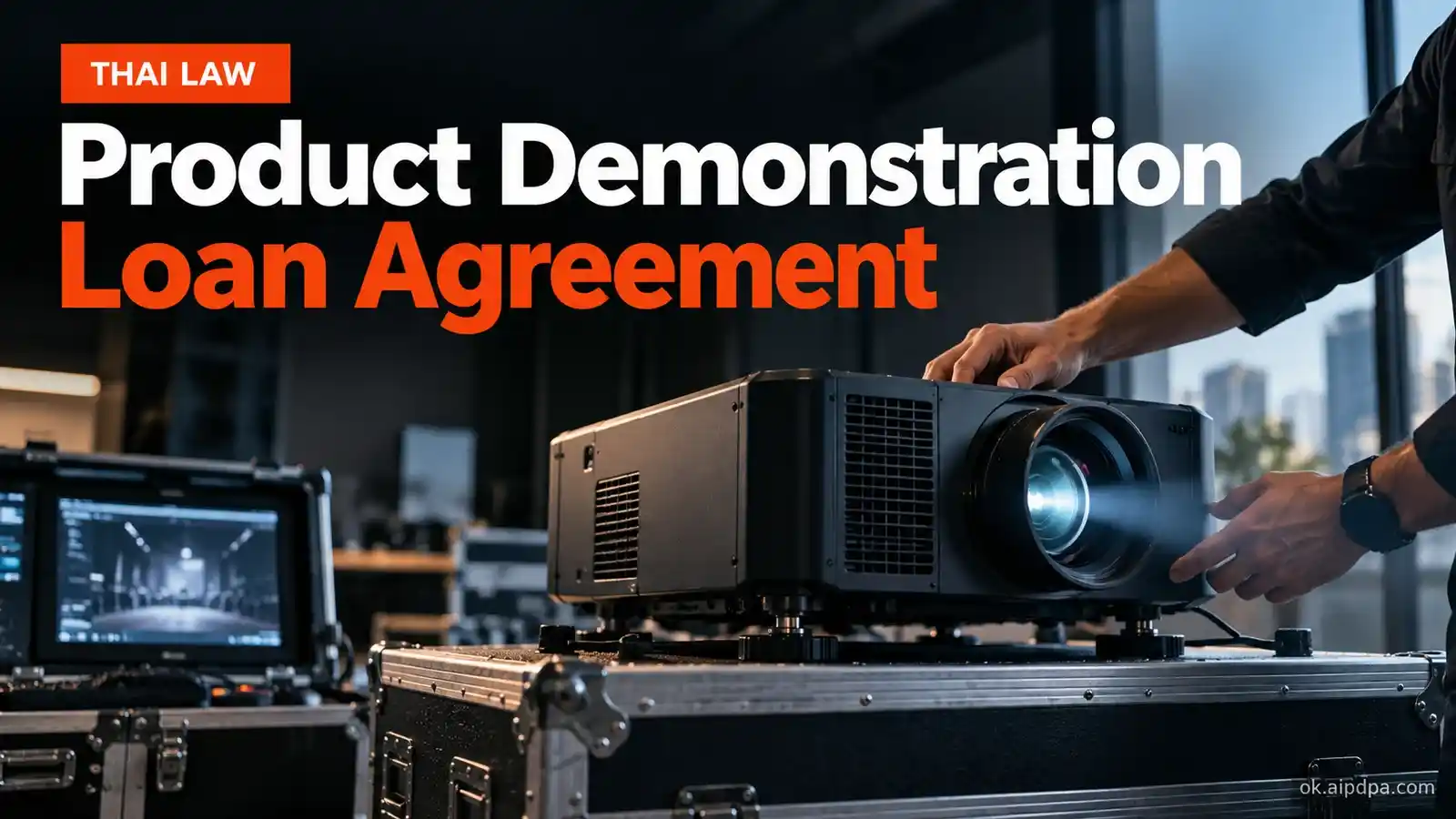
Loan & security · 5 min read
What should a Product Demonstration Loan Agreement include under Thai law?
Contents
The Product Demonstration Loan Agreement on this site is an English-language document drafted for use under Thai law. Its 15 clauses cover Definitions and Interpretation; Loan; Delivery and Condition; Use and Care; Risk and Insurance; Information, Safety and Data; Return; Late Return; Option to Buy; Liability; Confidentiality; Termination; Notices; Governing Law and Disputes; and General. The notes below explain A free loan, not a hire and Risk and insurance.
| Clauses in the template | 15 |
|---|---|
| Stamp duty | No stamp duty is payable on this Agreement. A loan for use is not an instrument listed in the Stamp Duty Schedule of the Thai Revenue Code. If the Borrower buys the Equipment under Clause 9, the sale is not subject to stamp duty either, but the Lender must issue a tax invoice and charge VAT if it is VAT-registered. For a price of 20,000 THB or more, the written purchase notice and this Agreement serve as the written evidence of the sale that Thai law requires. Lending demonstration equipment free of charge is normally not a taxable supply, but ask your accountant whether VAT or income tax applies to your particular arrangement, especially if the Equipment is later sold. |
| Language of the form | English |
| Price of the form on this site | 590 THB |
What the template covers
- Definitions and Interpretation
- Loan
- Delivery and Condition
- Use and Care
- Risk and Insurance
- Information, Safety and Data
- Return
- Late Return
- Option to Buy
- Liability
- Confidentiality
- Termination
- Notices
- Governing Law and Disputes
- General
A free loan, not a hire
- Under Thai law this is a loan for use: the Borrower uses the Equipment free of charge and must return the same Equipment (Civil and Commercial Code section 640). The loan takes effect only on delivery (section 641), so sign the handover note with photographs on the day the Equipment arrives (Clause 3.2).
- Do not charge any fee for the use of the Equipment. A fee turns the arrangement into a hire, with different rules and stamp duty.
- The Borrower must take care of the Equipment as a reasonable person would of its own property (section 644). If it uses the Equipment for another purpose, lets someone else use it outside the Permitted Use, or keeps it after the return date, it is liable for loss or damage even from causes beyond its control (section 643), and the Lender may end the loan (section 645). A loan for use ends if an individual Borrower dies (section 648).
Risk and insurance
- The Borrower carries the risk from delivery until return and must insure the Equipment for its Declared Value of …, naming the Lender as loss payee (Clause 5.1). Ask for the insurance certificate before you hand over the Equipment.- The Lender keeps its own insurance, and the Borrower is liable only for loss or damage it causes, including by misuse or late return (Clause 5.1). Check that the Lender's policy covers equipment at a customer's or dealer's premises and at trade fairs.
- The Borrower's liability is limited to the Declared Value, except for wilful acts, gross negligence or disposing of the Equipment (Clause 5.2). Make sure Schedule 1 states a realistic value for each item.
Claims must be made quickly
- A claim for compensation relating to a loan for use must be brought within 6 months after the loan ends (section 649), and the Parties cannot extend that period by agreement. Inspect the Equipment within 5 Business Days after its return (Clause 7.3), send the damage notice with quotations promptly, and use the independent assessor under Clause 7.4 if the Parties disagree.
- The late return amount is agreed compensation, capped at …% of the Declared Value (Clause 8.2). A Thai court may reduce an agreed amount that it finds excessive (section 383).
Product safety, licences and data
- Demonstrating a product to customers can count as offering it for sale under the Unsafe Products Liability Act B.E. 2551 (2008), so the Lender and a dealer who demonstrates it may be responsible to a person injured by an unsafe product. Train the staff who operate the Equipment (Clause 6.1) and keep a record of the training.
- Some products need an approval before they may be imported, advertised or demonstrated in Thailand, for example medical devices and radio equipment. Equipment brought in temporarily for a trade fair or demonstration may qualify for temporary admission without duty if it is re-exported; ask your customs broker before shipping.
- Delete personal data before return, and the Lender must erase anything left without looking at it (Clause 6.3). This matters for computers, medical devices, cameras and anything with a memory.
Stamp duty and tax
- No stamp duty is payable on this Agreement. A loan for use is not an instrument listed in the Stamp Duty Schedule of the Thai Revenue Code.
- If the Borrower buys the Equipment under Clause 9, the sale is not subject to stamp duty either, but the Lender must issue a tax invoice and charge VAT if it is VAT-registered. For a price of 20,000 THB or more, the written purchase notice and this Agreement serve as the written evidence of the sale that Thai law requires.
- Lending demonstration equipment free of charge is normally not a taxable supply, but ask your accountant whether VAT or income tax applies to your particular arrangement, especially if the Equipment is later sold.
Evidence to keep
- The signed Agreement, Schedule 1, the handover note with photographs, the training record and the insurance certificate.
- Every notice of damage, loss or theft, the police report if any, the return inspection report and the assessor's decision.
Signing and disputes
- Each Party signs through its authorised director or, for an individual, personally. Clause 15.5 allows electronic signatures and signed PDF copies.
- A Party may ask a court for an urgent order for the return of the Equipment even while a dispute is being discussed (Clause 14.4). A Thai court works in Thai, so a certified Thai translation of this Agreement is needed in court proceedings.
Author and sources
Compiled from the notes that accompany the English contract templates on this site, published by Phuwara Krobtaku (ภูวรา ครอบตะคุ), Thai attorney-at-law, licence no. 477/2558. The short answer and summary at the top of this page are put together by the site from the template's clause headings and notes. Statutes are quoted only in the official Thai text: Thai is the only official language of Thai legislation, and an unofficial translation can mislead. Article registry OKC-8A0534. If you reuse this content, please credit the author and link to the original.
Frequently asked questions
Does a Product Demonstration Loan Agreement need stamp duty in Thailand?
No stamp duty is payable on this Agreement. A loan for use is not an instrument listed in the Stamp Duty Schedule of the Thai Revenue Code. If the Borrower buys the Equipment under Clause 9, the sale is not subject to stamp duty either, but the Lender must issue a tax invoice and charge VAT if it is VAT-registered. For a price of 20,000 THB or more, the written purchase notice and this Agreement serve as the written evidence of the sale that Thai law requires. Lending demonstration equipment free of charge is normally not a taxable supply, but ask your accountant whether VAT or income tax applies to your particular arrangement, especially if the Equipment is later sold.
How should a Product Demonstration Loan Agreement be signed?
Each Party signs through its authorised director or, for an individual, personally. Clause 15.5 allows electronic signatures and signed PDF copies. A Party may ask a court for an urgent order for the return of the Equipment even while a dispute is being discussed (Clause 14.4). A Thai court works in Thai, so a certified Thai translation of this Agreement is needed in court proceedings.
What happens if a Product Demonstration Loan Agreement ends up in a dispute in Thailand?
Each Party signs through its authorised director or, for an individual, personally. Clause 15.5 allows electronic signatures and signed PDF copies. A Party may ask a court for an urgent order for the return of the Equipment even while a dispute is being discussed (Clause 14.4). A Thai court works in Thai, so a certified Thai translation of this Agreement is needed in court proceedings.
What evidence should I keep for a Product Demonstration Loan Agreement?
The signed Agreement, Schedule 1, the handover note with photographs, the training record and the insurance certificate. Every notice of damage, loss or theft, the police report if any, the return inspection report and the assessor's decision.
What clauses does a Product Demonstration Loan Agreement on this site include?
Definitions and Interpretation; Loan; Delivery and Condition; Use and Care; Risk and Insurance; Information, Safety and Data; Return; Late Return; Option to Buy; Liability; Confidentiality; Termination; Notices; Governing Law and Disputes; General
Thai law cited (official Thai text)
The 14 sections below are quoted from the official Thai text, the only official language of Thai legislation. No translation is given, because an unofficial translation can mislead; check the Royal Gazette before relying on them in court.
ประมวลกฎหมายแพ่งและพาณิชย์ มาตรา 640
อันว่ายืมใช้คงรูปนั้น คือสัญญาซึ่งบุคคลคนหนึ่ง เรียกว่าผู้ให้ยืม ให้บุคคลอีกคนหนึ่ง เรียกว่าผู้ยืม ใช้สอยทรัพย์สินสิ่งใดสิ่งหนึ่งได้เปล่า และผู้ยืมตกลงว่าจะคืนทรัพย์สินนั้น เมื่อได้ใช้สอยเสร็จแล้ว
หมวด 1 ยืมใช้คงรูป
ประมวลกฎหมายแพ่งและพาณิชย์ มาตรา 641
การให้ยืมใช้คงรูปนั้น ท่านว่าย่อมบริบูรณ์ต่อเมื่อส่งมอบทรัพย์สินซึ่งให้ยืม
หมวด 1 ยืมใช้คงรูป
ประมวลกฎหมายแพ่งและพาณิชย์ มาตรา 642
ค่าฤชาธรรมเนียมในการทำสัญญาก็ดี ค่าส่งมอบและค่าส่งคืนทรัพย์สินซึ่งยืมก็ดี ย่อมตกแก่ผู้ยืมเป็นผู้เสีย
หมวด 1 ยืมใช้คงรูป
ประมวลกฎหมายแพ่งและพาณิชย์ มาตรา 643
ทรัพย์สินซึ่งยืมนั้น ถ้าผู้ยืมเอาไปใช้การอย่างอื่นนอกจากการอันเป็นปกติแก่ทรัพย์สินนั้น หรือนอกจากการอันปรากฏในสัญญาก็ดี เอาไปให้บุคคลภายนอกใช้สอยก็ดี เอาไปไว้นานกว่าที่ควรจะเอาไว้ก็ดี ท่านว่าผู้ยืมจะต้องรับผิดในเหตุทรัพย์สินนั้นสูญหายหรือบุบสลายไปอย่างหนึ่งอย่างใด แม้ถึงจะเป็นเพราะเหตุสุดวิสัย เว้นแต่จะพิสูจน์ได้ว่าถึงอย่างไร ๆ ทรัพย์สินนั้นก็คงจะต้องสูญหายหรือบุบสลายอยู่นั่นเอง
หมวด 1 ยืมใช้คงรูป
ประมวลกฎหมายแพ่งและพาณิชย์ มาตรา 644
ผู้ยืมจำต้องสงวนทรัพย์สินซึ่งยืมไปเหมือนเช่นวิญญูชนจะพึงสงวนทรัพย์สินของตนเอง
หมวด 1 ยืมใช้คงรูป
ประมวลกฎหมายแพ่งและพาณิชย์ มาตรา 645
ในกรณีทั้งหลายดังกล่าวไว้ในมาตรา 643 นั้นก็ดี หรือถ้าผู้ยืมประพฤติฝ่าฝืนต่อความในมาตรา 644 ก็ดี ผู้ให้ยืมจะบอกเลิกสัญญาเสียก็ได้
หมวด 1 ยืมใช้คงรูป
ประมวลกฎหมายแพ่งและพาณิชย์ มาตรา 646
ถ้ามิได้กำหนดเวลากันไว้ ท่านให้คืนทรัพย์สินที่ยืมเมื่อผู้ยืมได้ใช้สอยทรัพย์สินนั้นเสร็จแล้วตามการอันปรากฏในสัญญา แต่ผู้ให้ยืมจะเรียกคืนก่อนนั้นก็ได้เมื่อเวลาได้ล่วงไปพอแก่การที่ผู้ยืมจะได้ใช้สอยทรัพย์สินนั้นเสร็จแล้ว
หมวด 1 ยืมใช้คงรูป
ประมวลกฎหมายแพ่งและพาณิชย์ มาตรา 647
ค่าใช้จ่ายอันเป็นปกติแก่การบำรุงรักษาทรัพย์สินซึ่งยืมนั้น ผู้ยืมต้องเป็นผู้เสีย
หมวด 1 ยืมใช้คงรูป
ประมวลกฎหมายแพ่งและพาณิชย์ มาตรา 648
อันการยืมใช้คงรูป ย่อมระงับสิ้นไปด้วยมรณะแห่งผู้ยืม
หมวด 1 ยืมใช้คงรูป
ประมวลกฎหมายแพ่งและพาณิชย์ มาตรา 649
ในข้อความรับผิดเพื่อเสียค่าทดแทนอันเกี่ยวกับการยืมใช้คงรูปนั้น ท่านห้ามมิให้ฟ้องเมื่อพ้นเวลาหกเดือนนับแต่วันสิ้นสัญญา
หมวด 1 ยืมใช้คงรูป
ประมวลกฎหมายแพ่งและพาณิชย์ มาตรา 383
ถ้าเบี้ยปรับที่ริบนั้นสูงเกินส่วน ศาลจะลดลงเป็นจำนวนพอสมควรก็ได้ ในการที่จะวินิจฉัยว่าสมควรเพียงใดนั้น ท่านให้พิเคราะห์ถึงทางได้เสียของเจ้าหนี้ทุกอย่างอันชอบด้วยกฎหมาย ไม่ใช่แต่เพียงทางได้เสียในเชิงทรัพย์สิน เมื่อได้ใช้เงินตามเบี้ยปรับแล้ว สิทธิเรียกร้องขอลดก็เป็นอันขาดไป
หมวด 3 มัดจำและกำหนดเบี้ยปรับ
ประมวลกฎหมายแพ่งและพาณิชย์ มาตรา 373
ความตกลงทำไว้ล่วงหน้าเป็นข้อความยกเว้นมิให้ลูกหนี้ต้องรับผิดเพื่อกลฉ้อฉล หรือความประมาทเลินเล่ออย่างร้ายแรงของตนนั้น ท่านว่าเป็นโมฆะ
หมวด 2 ผลแห่งสัญญา
พ.ร.บ.ความรับผิดต่อความเสียหายที่เกิดขึ้นจากสินค้าที่ไม่ปลอดภัย พ.ศ. 2551 มาตรา 4
ในพระราชบัญญัตินี้ “สินค้า” หมายความว่า สังหาริมทรัพย์ทุกชนิดที่ผลิตหรือนำเข้าเพื่อขาย รวมทั้งผลิตผลเกษตรกรรม และให้หมายความรวมถึงกระแสไฟฟ้า ยกเว้นสินค้าตามที่กำหนดในกฎกระทรวง “ผลิตผลเกษตรกรรม” หมายความว่า ผลิตผลอันเกิดจากเกษตรกรรมต่าง ๆ เช่น การทำนา ทำไร่ ทำสวน เลี้ยงสัตว์ เลี้ยงสัตว์น้ำ เลี้ยงไหม เลี้ยงครั่ง เพาะเห็ด แต่ไม่รวมถึงผลิตผลที่เกิดจากธรรมชาติ “ผลิต” หมายความว่า ทำ ผสม ปรุง แต่ง ประกอบ ประดิษฐ์ แปรสภาพ เปลี่ยนรูป ดัดแปลง คัดเลือก แบ่งบรรจุ แช่เยือกแข็ง หรือฉายรังสี รวมถึงการกระทำใด ๆ ที่มีลักษณะทำนองเดียวกัน “ผู้เสียหาย” หมายความว่า ผู้ได้รับความเสียหายอันเกิดจากสินค้าที่ไม่ปลอดภัย “ความเสียหาย” หมายความว่า ความเสียหายที่เกิดจากสินค้าที่ไม่ปลอดภัยไม่ว่าจะเป็นความเสียหายต่อชีวิต ร่างกาย สุขภาพ อนามัย จิตใจ หรือทรัพย์สิน ทั้งนี้ ไม่รวมถึงความเสียหายต่อตัวสินค้าที่ไม่ปลอดภัยนั้น “ความเสียหายต่อจิตใจ” หมายความว่า ความเจ็บปวด ความทุกข์ทรมาน ความหวาดกลัว ความวิตกกังวล ความเศร้าโศกเสียใจ ความอับอาย หรือความเสียหายต่อจิตใจอย่างอื่นที่มีลักษณะทำนองเดียวกัน “สินค้าที่ไม่ปลอดภัย” หมายความว่า สินค้าที่ก่อหรืออาจก่อให้เกิดความเสียหายขึ้นได้ไม่ว่าจะเป็นเพราะเหตุจากความบกพร่องในการผลิตหรือการออกแบบ หรือไม่ได้กำหนดวิธีใช้ วิธีเก็บรักษา คำเตือน หรือข้อมูลเกี่ยวกับสินค้า หรือกำหนดไว้แต่ไม่ถูกต้องหรือไม่ชัดเจนตามสมควร ทั้งนี้ โดยคำนึงถึงสภาพของสินค้า รวมทั้งลักษณะการใช้งานและการเก็บรักษาตามปกติธรรมดาของสินค้าอันพึงคาดหมายได้ “ขาย” หมายความว่า จำหน่าย จ่าย แจก หรือแลกเปลี่ยนเพื่อประโยชน์ทางการค้า และให้หมายความรวมถึงให้เช่า ให้เช่าซื้อ จัดหา ตลอดจนเสนอ ชักชวน หรือนำออกแสดงเพื่อการดังกล่าว “นำเข้า” หมายความว่า นำหรือสั่งสินค้าเข้ามาในราชอาณาจักเพื่อขาย “ผู้ประกอบการ” หมายความว่า (1) ผู้ผลิต หรือผู้ว่าจ้างให้ผลิต (2) ผู้นำเข้า (3) ผู้ขายสินค้าที่ไม่สามารถระบุตัวผู้ผลิต ผู้ว่าจ้างให้ผลิต หรือผู้นำเข้าได้ (4) ผู้ซึ่งใช้ชื่อ ชื่อทางการค้า เครื่องหมายการค้า เครื่องหมาย ข้อความหรือแสดงด้วยวิธีใด ๆ อันมีลักษณะที่จะทำให้เกิดความเข้าใจได้ว่าเป็นผู้ผลิต ผู้ว่าจ้างให้ผลิตหรือผู้นำเข้า
พระราชบัญญัติความรับผิดต่อความเสียหายที่เกิดขึ้นจากสินค้าที่ไม่ปลอดภัย พ.ศ. 2551
ประมวลกฎหมายแพ่งและพาณิชย์ มาตรา 456
การซื้อขายอสังหาริมทรัพย์ ถ้ามิได้ทำเป็นหนังสือและจดทะเบียนต่อพนักงานเจ้าหน้าที่เป็นโมฆะ วิธีนี้ให้ใช้ถึงซื้อขายเรือมีระวางตั้งแต่ห้าตันขึ้นไป ทั้งซื้อขายแพและสัตว์พาหนะด้วย
ส่วนที่ 1 บทเบ็ดเสร็จทั่วไป
More in Loan & security
 What should an Acknowledgment of Debt include under Thai law?Practical notes on the Acknowledgment of Debt under Thai law: Stamp duty; Effect on the time limit for suing; If the original debt has a guarantor; Signing; Evidence to keep; and Collecting the debt.
 What should a Loan and Guarantee Agreement include under Thai law?Practical notes on the Loan and Guarantee Agreement under Thai law: Stamp duty; Receipts and evidence of repayment; Money coming from or going abroad; Protecting the guarantee; Before signing; and 1 more.
 What should a Mortgage Agreement Addendum (Land, Building or Machinery) include under Thai law?Practical notes on the Mortgage Agreement Addendum (Land, Building or Machinery) under Thai law: What this Addendum does, and what it does not do; Stamp duty; Interest and tax; A director securing a company's debt; If the Debtor does not pay; and 3 more.
 What should a Personal Guarantee include under Thai law?Practical notes on the Personal Guarantee under Thai law: Rules that protect an individual guarantor; What the Creditor must do if the Debtor defaults; Stamp duty; Signing; While the Guarantee is in force; and 1 more.
 What should a Personal Loan Agreement include under Thai law?Practical notes on the Personal Loan Agreement under Thai law: Hand over the money and keep the proof; Stamp duty; Repayments and receipts; If the Borrower does not pay; Taxes and money transfers; and 1 more.
 What should a Share Pledge Agreement include under Thai law?Practical notes on the Share Pledge Agreement under Thai law: Complete these steps on the signing day; Stamp duty; Dividends, voting and tax; If the debt is not paid; Things to know; Signing; and 1 more.